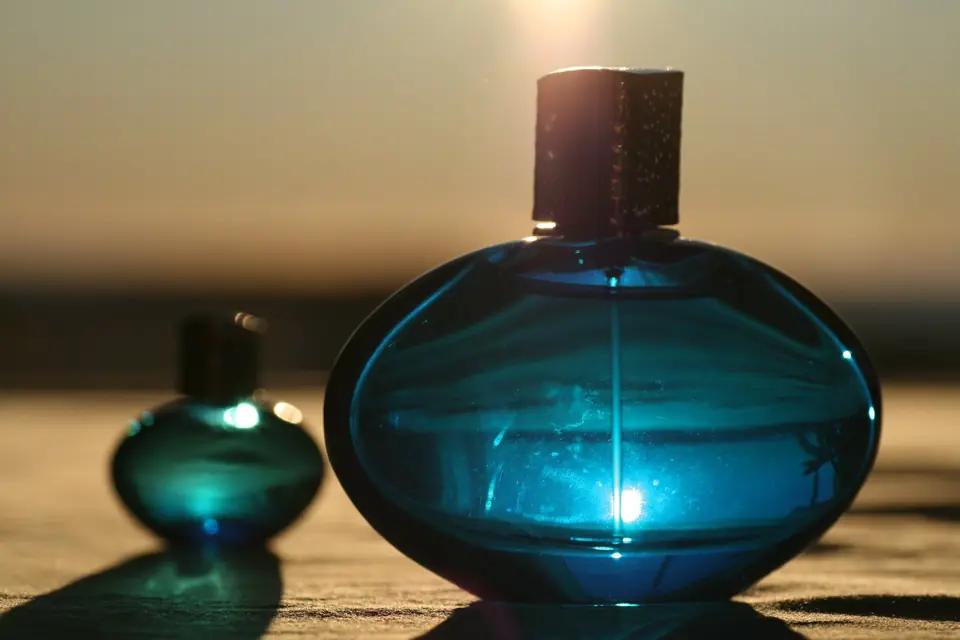
How to light a glass bottle from behind
Put a large diffused light behind the bottle, a softbox or a sheet of diffusion with a lamp behind it, and stand the bottle in front of its centre. The glass turns bright, and dark lines form along the edges where it curves away. This is bright-field lighting. Black cards just outside the frame on each side make those edge lines thicker and sharper.
For the opposite look, stand the bottle in front of black and light two white panels to each side and slightly behind it. The edges now catch thin white lines against a dark ground. This dark-field set suits clear glass and traces the outline from the base to the shoulder.
Making the liquid glow
Against a plain backlight, perfume can look thin and grey. Cut a piece of white card or silver foil to the bottle's shape, a little smaller, and stand it directly behind the bottle where the camera cannot see it. It throws light straight through the liquid so the colour glows. A gold card warms a pale perfume.
Most spray bottles have a thin dip tube running from the pump into the liquid. Turn the bottle until the tube sits on the centre line behind the label, or along the back edge, where it disappears. On a dummy bottle the tube can come out, and the liquid can be swapped for tinted water whose colour is easier to adjust. Drinks get this treatment too: on a styled bar cart, cold tea stands in for whisky.
Lighting the label and the cap
Backlight leaves the front label dark. Add a small soft light or a white card from the front and to one side, flagged so it reaches the label and does not wash over the glass. Check the label faces the camera squarely; a bottle turned a few degrees foreshortens the text towards one side.
Metal caps reflect the whole room. Surround them with white and black cards, as for polished rings and chains, or take the shine off a chrome cap with dulling spray. A strip softbox to one side puts a long, clean highlight down one side of the bottle.
Cleaning glass and adding drops
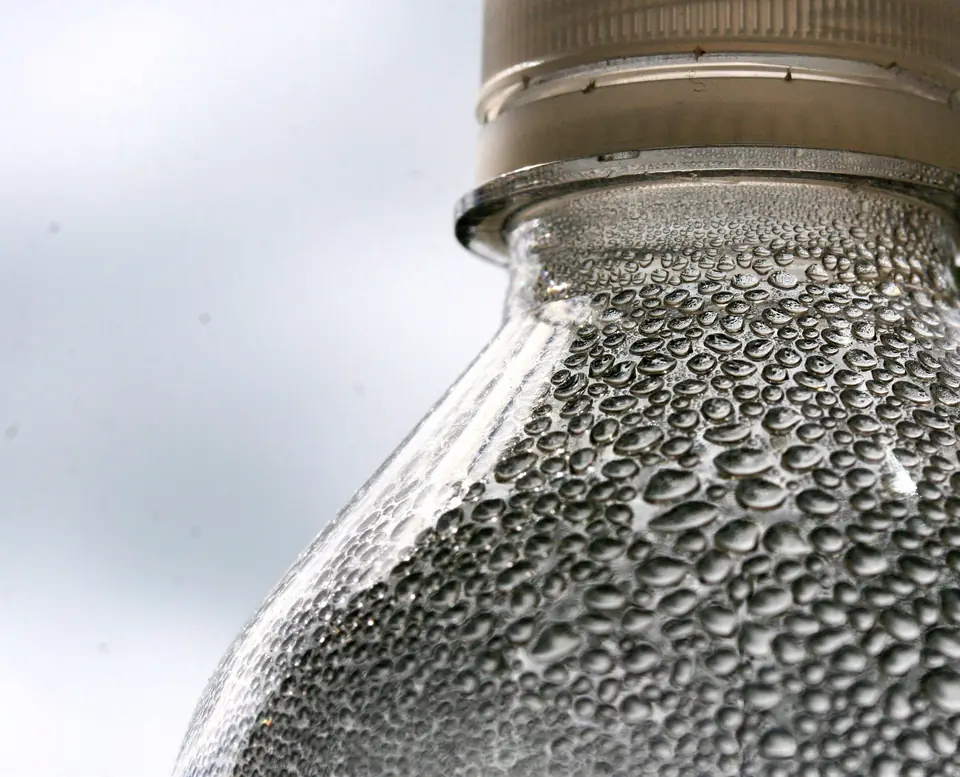
In backlight, glass shows every fingerprint and speck of dust. Wear gloves, clean with a lint-free cloth and a little glass cleaner, then use a blower. For condensation, spray on a mix of glycerine and water. The drops stay round and hold their place under the lights, where plain water runs and dries. Place large single drops with a pipette.
Setting up a bottle shot
- Polish the bottle, then handle it only in gloves.
- Turn the bottle until the dip tube hides behind its centre line.
- Set the backlight and stand the bottle in front of it.
- Add black side cards for bright-field, or white side panels on black for dark-field, until the outline is crisp.
- Slip a cut card behind the bottle to make the liquid glow.
- Light the label from the front with a small flagged light.
- Deal with the cap last, then add glycerine drops if the picture needs them.
Mistakes with glass bottles
- Lighting the bottle only from the front. The glass goes flat and the reflections hide its shape; light from behind first.
- Leaving the dip tube on view. It cuts through the liquid as a dark line, so rotate the bottle or remove the tube from a dummy.
- Spraying plain water for condensation. It runs and dries under the lights; mix in glycerine.
- Standing clear glass in front of a busy surface. Everything behind the bottle shows through it, bent out of shape, so keep that area plain.
Questions about photographing perfume
Does a polarising filter help with perfume bottles?
It reduces reflections on glass and liquid, which helps on a front-lit shot. On a backlit bottle it matters less, because the outline comes from light passing through the glass; turn it slowly and watch which reflections change.
How are perfume bottles made to look as if they float?
The bottle stands on a small clear acrylic block or a support from behind, which is retouched out. A sheet of black acrylic underneath adds a reflection that suggests a surface without one being seen.
What background suits a clear perfume bottle?
Plain white or a smooth gradient for bright-field, black for dark-field. A coloured background works too, but its colour shows through the glass and mixes with the colour of the liquid.
 Jewellery photography setup: small surfaces, holding pieces and reflections
 Product photography props: stones, plinths and risers
 How a mirror installation is built: mirror boxes, rooms and infinity effects