Speakers: grilles and glossy cabinets
Fabric grilles collect lint and show every fibre close up, so go over them with a lint roller before each set-up. Fine mesh grilles can produce moiré, a wavy pattern that appears where the mesh clashes with the grid of the camera sensor. Move the camera slightly closer or further away, or change the angle, until the pattern disappears when you zoom in on the screen.
Gloss lacquer and black piano finishes work like dark mirrors. Use a large diffused light so the reflection becomes a smooth gradient, and flag off the room so it does not appear in the finish. Wear cotton gloves to place the speaker, because every fingerprint shows.
Turntables and records
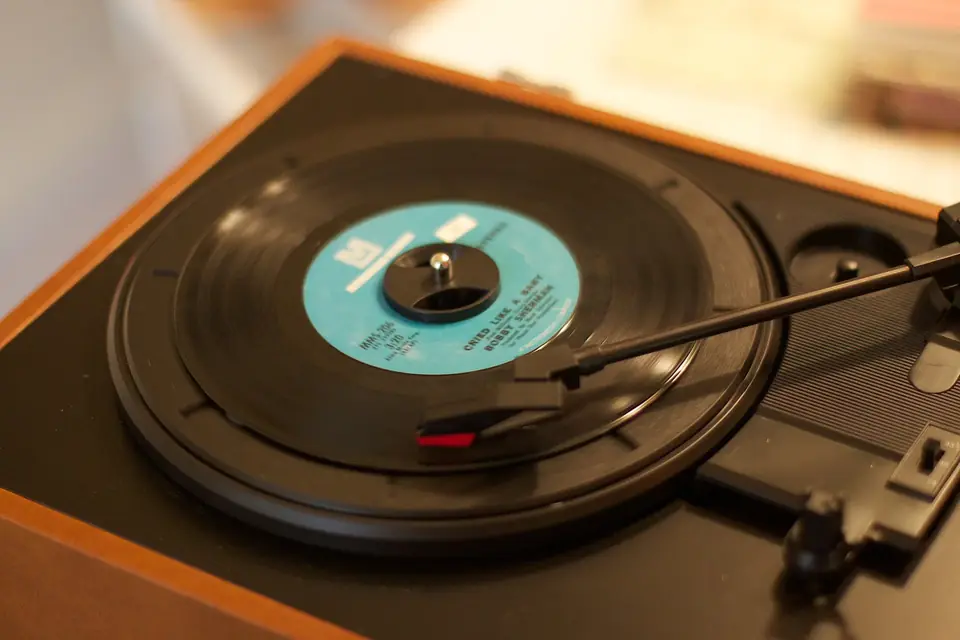
Take the dust cover off, since its clear plastic reflects lights and the room. Park the tonearm on its rest, fit or remove the stylus guard as the shot needs, and check the platter mat is centred. A 12-inch record is about 30 cm across, so a turntable needs a deeper table than a bottle set and a camera far enough back to see the plinth and arm together.
Records add colour and graphics. Lean a sleeve behind the turntable or stand a few records in a crate beside it. To show the platter turning, use a slow shutter speed with the record spinning: the label blurs into rings while the turntable stays sharp, as long as the camera is on a tripod.
Headphones
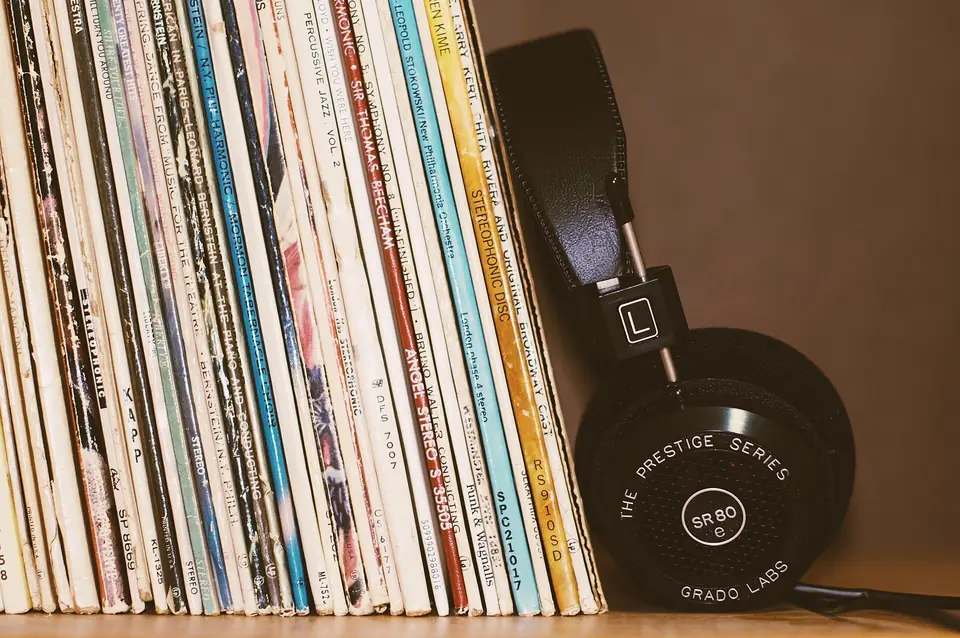
Headphones can hang on a stand, lie flat, or rest over an object such as a stack of records. Lying flat, the headband looks wider than it does when worn, so turn one ear cup slightly towards the camera. A small block or rolled tissue inside the band holds a natural curve. Clean the ear pads with a lint roller and straighten the cable, or detach it if the model allows.
Hiding cables
A cable crossing the frame pulls the eye away from the product. Run it straight back behind the object, then down through a hole drilled in the surface board. It can also go under the paper sweep of the backdrop and off the back of the table. Tape it underneath with gaffer tape so it cannot spring back into view.
Small indicator lights are easily overexposed. Shoot one frame for the product and a second, darker frame for the light, then combine the two in retouching.
Order of work
- Clean the object: lint roller on fabric, gloves on gloss.
- Choose a surface that matches its material, such as oak for a vintage speaker or concrete for a modern one.
- Plan the cable route before placing anything, and drill the board if needed.
- Set the camera on a tripod and check any grille for moiré at full magnification.
- Light with a large diffused source and flag reflections on gloss and plastic.
- Add one or two supporting objects, such as a record sleeve, then shoot.
- Shoot a separate frame for indicator lights if they need to show.
Common mistakes
- Leaving the turntable lid on. It reflects the lights and the room; take it off for the shot.
- Letting a cable loop across the frame. Plan its route first and drill the board where it needs to drop.
- Missing moiré on a grille. It often shows only when you zoom in, so check at full magnification before moving on.
- Lighting a gloss cabinet with a small hard light. It leaves a harsh hot spot; use a large soft source.
Questions people ask
How do you photograph a vintage speaker?
Clean the grille and the wood, place it on a warm surface such as oak or linen, and light from the side to show the grain. Keep the cable behind it and out of frame.
Should records be shown out of their sleeves?
One record half out of its sleeve shows both the disc and the sleeve artwork. Hold it by the edges and the label, since the playing surface shows fingerprints under light.
How do headphones look good in a flat lay?
Turn the ear cups so one faces the camera, shape the band with a small support inside, and coil or remove the cable. A plain surface in a colour that contrasts with the headphones keeps the outline clear.
 Still life set up: surface, backdrop, light and props in the right order
 Photography surfaces: plaster, concrete, linen, paper and how to make your own
 Interior photo shoot styling: preparing a home for a magazine
