
Why scaffold tube works for rails
Scaffold tube has a standard outside diameter of 48.3 mm, so every coupler and fitting made for it fits every tube. That makes rails modular: the same tubes become a free-standing rail, a ceiling-hung bar in a small showroom or a frame for shelves and lights. Scaffold suppliers sell tube in set lengths, and many will cut it to size.
Weight is the drawback. Standard steel tube with a 4 mm wall weighs roughly 4.4 kg per metre, so a rail with two uprights, a top bar and feet takes two people to carry. Aluminium tube of the same outside diameter weighs less than half as much and takes the same size fittings, but it is softer and dents more easily. For a fashion show with one rail per model, the lighter tube saves a lot of carrying.
Couplers or slip-on fittings
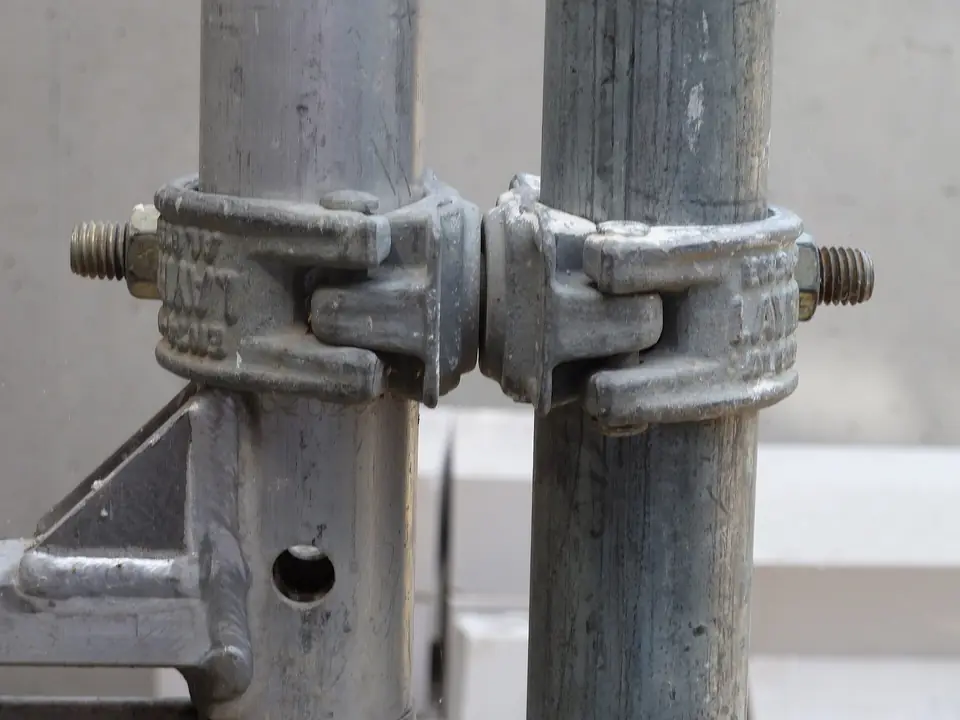
There are two ways to join tube. Scaffold couplers are the clamps from building sites: a right-angle coupler for a 90° joint, a swivel coupler for any other angle, a sleeve coupler to join two tubes end to end. They grip anywhere along a tube and tighten with a scaffold spanner.
Slip-on fittings are cast tees, elbows, crosses and flanges that the tube slides into, each held by a grub screw tightened with a hex key. They make neater joints with no bolts sticking out, and a flange screwed to the floor or a beam makes a fixed rail. These fittings come in several tube sizes, so check they are made for 48.3 mm before ordering.
Sizes and heights for a clothes rail
On a scaffold clothes rail for long coats and dresses, set the top bar at about 1.7 to 1.8 m so hems clear the floor. A rail for shirts and jackets can sit around 1.2 m, or run as a second bar below a high one. Keep the span between uprights modest: a long rail bends under a full load and sways when people pull clothes from it, so add a middle upright on a long run.
A free-standing rail needs feet. Stand each upright on a scaffold base plate, a square steel plate with a short spigot, and join the uprights with a bottom bar so they cannot spread. A short tube clamped across the base of each upright adds stability. Pad every plate and foot with felt or rubber so floors are not scratched.
Finishes that keep clothes clean
Used scaffold tube arrives dull, scratched and often greasy, and the zinc of galvanised tube leaves grey marks on pale fabric. Scrub it with degreaser and wire wool, then seal the hanging bar with clear lacquer. New galvanised tube has a brighter, crystalline surface but still needs a wipe-down.
Paint does not hold on bare galvanised steel without an etch primer underneath. Powder coating works if the coater knows the tube is galvanised, since trapped gas can blister the coat. Cap or file every cut end, because a raw edge snags knitwear. Test your hangers before the day too: some slim hanger hooks are too tight to sit on a tube this thick.
Building a free-standing rail
- Measure the longest garment on its hanger and add a few centimetres to set the rail height.
- Cut the uprights, top bar, bottom bar and feet to length, then file and cap every cut end.
- Clean and finish the tube before assembly, while every surface is easy to reach.
- Join the top bar to the uprights with right-angle couplers or slip-on elbows.
- Set the uprights on base plates, add the bottom bar and cross feet, and pad everything that touches the floor.
- Check the uprights with a spirit level, then tighten every fitting fully.
- Load the rail and push it gently from the side; add a brace or a middle upright if it sways.
Common mistakes
- Hanging pale clothes on uncleaned tube. Zinc and grime mark fabric; clean and seal the bar first.
- Spraying ordinary paint on galvanised tube. It flakes off; use an etch primer first.
- Building a long rail on two uprights. It sways when a crowd pulls at it; add a middle upright or a brace.
- Bringing hangers untested. Some hooks are too tight for 48.3 mm tube; try one of each type first.
Questions people ask
What size is scaffold tube?
Standard scaffold tube is 48.3 mm in outside diameter. Steel tube usually has a wall of about 4 mm, and aluminium tube of the same outside diameter has a thicker wall to make up for the softer metal. Standard couplers are made to fit that diameter.
Do normal hangers fit a scaffold rail?
Many do, but hanger hooks vary, and some slim or velvet-covered hangers are too tight for a tube this thick. Try one of each type before the day. If they do not fit, use a thinner tube with matching slip-on fittings for the hanging bar.
Can a scaffold rail hang from the ceiling?
Yes, on flanges or drop rods fixed into joists, beams or another structural point, and never from a suspended ceiling grid. A full rail of coats is heavy, so every fixing has to go into the structure of the building.
 Small showroom design: rails, mirrors, a fitting corner and tables
 Pop-up shop design: planning an empty unit from the door to the till
 Fashion show set design for a small show: runway, seating, backstage and light
